
Digitalization, stricter anti-corruption rules, FPI-BOC cooperation seen to transform Customs operations
Federation of Philippine Industries (FPI) Chairman Emeritus Dr. Jesus L. Arranza expressed strong confidence that the reforms being carried out by Customs Commissioner Ariel F. Nepomuceno will help realize President Ferdinand R. Marcos Jr.’s SONA promise to end the reign of smugglers in the country.
Arranza said the initiatives presented by Nepomuceno before more than 200 business and industry leaders that attended the recently concluded FPI Business Summit 2025 are “bold and systemic reforms that will change the Bureau of Customs’ image from one of the most corrupt to one of the most reformed.”
“These reforms will help restore the credibility of the Bureau of Customs. We in the FPI, who have long been victims of smuggling and illicit trade, are the first to feel the negative impact of these illegal activities — and we will also be the first to commend genuine reform efforts,” Arranza said.
Digitalization to Eliminate Human Contact and Corruption
At the core of Nepomuceno’s reform agenda is the full digitalization of customs processes, which aims to eliminate face-to-face transactions between importers and Customs personnel.
The modernization effort, to be implemented through a Public-Private Partnership (PPP) model, will automate import documentation, inspection tracking, and valuation processes — removing the opportunities for collusion, bribery, and technical smuggling.
Strict Ban on Customs Officials’ Business Interests
In a major anti-corruption measure, Nepomuceno issued a landmark memorandum prohibiting all Bureau of Customs officials, employees, and personnel from holding any business or financial interest in Customs Brokerage operations.
The policy, anchored on Section 12, Rule XVIII of the Revised Civil Service Rules, extends beyond ownership and includes roles such as incorporator, consultant, or advisor in any brokerage-related entity.
All BOC personnel are now required to submit verified affidavits disclosing any relatives within the fourth civil degree who are involved in brokerage operations. Failure to comply could lead to disciplinary or legal action.
“This is part of our commitment to good governance and transparency,” Nepomuceno said. “There should be no conflict of interest in Customs service.”
Suspension and Review of Pending Mission Orders
Another key reform is the temporary suspension of all previously approved but unserved Letters of Authority (LOAs) and Mission Orders (MOs) issued before July 2, 2025.
Nepomuceno ordered a comprehensive review of all pending enforcement actions under the Intelligence and Enforcement Groups to ensure they are “legally sound, properly documented, and aligned with current priorities.”
“We want all enforcement actions to be traceable and accountable,” he said. “This is a step toward cleaning up operational loopholes.”
BOC–FPI Partnership Against Smuggling
Arranza also highlighted the Memorandum of Agreement (MOA) forged by the FPI and BOC, which institutionalizes cooperation to curb smuggling and illicit trade.
The agreement strengthens the joint monitoring system between the BOC and FPI’s Industry Technical Experts (ITEs) and ensures regular feedback on inspection findings. It also outlines continuing discussions on key reform issues, including:
Real-time sharing of Inward Foreign Manifests (IFM);
Deployment of Industry Commodity Experts (ICE);
Declaring smuggling as a non-bailable offense;
Allowing affected companies to file criminal complaints;
Preventing lower courts from issuing TROs/Injunctions in standards-related cases; and
Tracking data on smuggling cases and consolidators.
Restoring Credibility and Investor Confidence
Arranza said these initiatives could finally help cleanse the BOC of its reputation as a “corrupt agency,” — a stigma recently echoed in the U.S. Department of State’s Annual Investment Climate Report released last September and with 2024 as the year in review, which cited complaints from American businessmen about “facilitation fees” and bureaucratic hurdles at the BOC.
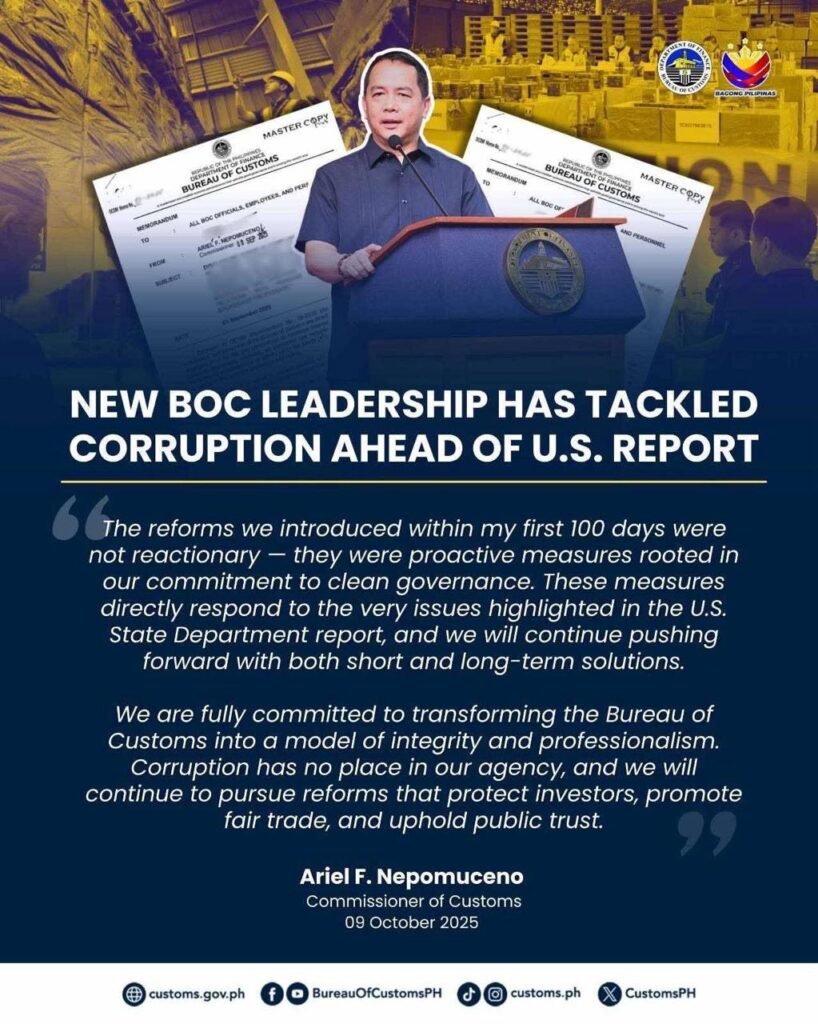
Nepomuceno has responded to the Department of State’s report, noting that “the reforms we introduced within the my first 100 days were not reactionary –- they were proactive measures rooted in our commitment to clean governance. These measures directly respond to the very issues highlighted in the US State Department report, and we will continue pushing forward with both short and long-term solutions.”
Arranza said the FPI — composed of manufacturers and industry associations that suffer directly from smuggling and illicit trade — can provide the most reliable assessment of the BOC’s performance.
“I personally know the Commissioner, and he is a man who cannot be compromised. We see Nepomuceno as the lifesaver of the manufacturing sector, and we thank President Marcos for appointing him,” Arranza said.
In his second SONA, President Marcos declared: “Bilang na ang araw ng mga smugglers.”
Nepomuceno said that while he could not promise to “completely eradicate” smuggling, his goal is to “make it very difficult for anyone to commit.”